Current Book Projects
Waking the Jinn: Cultural Memories, Writings, and Assemblages
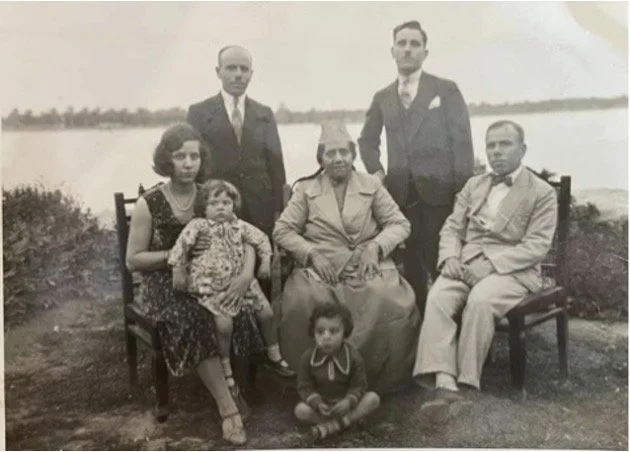
Photo of my family, the Saleh family, on the Shatt Al-Arab River in Basra, Iraq. In the 1940s, around 160,000 Iraqi Jews were living in Iraq. Today, only three remain. My family's stories about their ancestral homeland and forced exile provide the personal impetus for my research on Jewish rhetorics.My monograph, Waking the Jinn: Cultural Memories, Writings, and Assemblages, builds upon theories of assemblage by examining how overlooked cultural contexts can reshape our understandings of rhetoric and memory.
Focusing on tombstones in the first Iraqi Jewish cemetery in Long Island, New York, I explore how communal memory is preserved and circulated through the borrowing, repurposing, and transformation of cultural commonplaces across time and space.
Bringing cultural rhetorics into sustained conversation with Jewish studies, particularly Mizrahi studies, I trace how Iraqi Jewish iconographic and linguistic writing practices conceal information from select audiences through what I term strategic illegibility. These practices create an explicitly Jewish rhetorical space while asserting communal agency and preserving cultural knowledge.
The manuscript proposal has been accepted for consideration in the Rhetoric Society of America’s Transdisciplinary Rhetoric Series at Penn State University Press, and I am currently developing the manuscript toward publication.
Strategic Illegibility: Rhetorics of Nontranslation
Co-edited with Raúl Sánchez, this collection explores the theory and practice of marginalized communities choosing not to translate or transpose their ideas into dominant forms, thereby refusing to be understood on terms other than their own. Organized around research and pedagogy, cultural theory, and community, the chapters in this collection position strategic illegibility as a complementary practice to translation, translanguaging, and translingualism. Contributors explore what writing reveals and obscures, how texts mark readers as insiders and outsiders, and when demands for translation may compromise a community's rhetorical sovereignty. Overall, the collection challenges assumptions about legibility and translation by prompting readers to reconsider the purposes and functions of writing, as well as the preconceptions they bring to their research and teaching.
Strategic illegibility is currently in production with Utah State University Press.